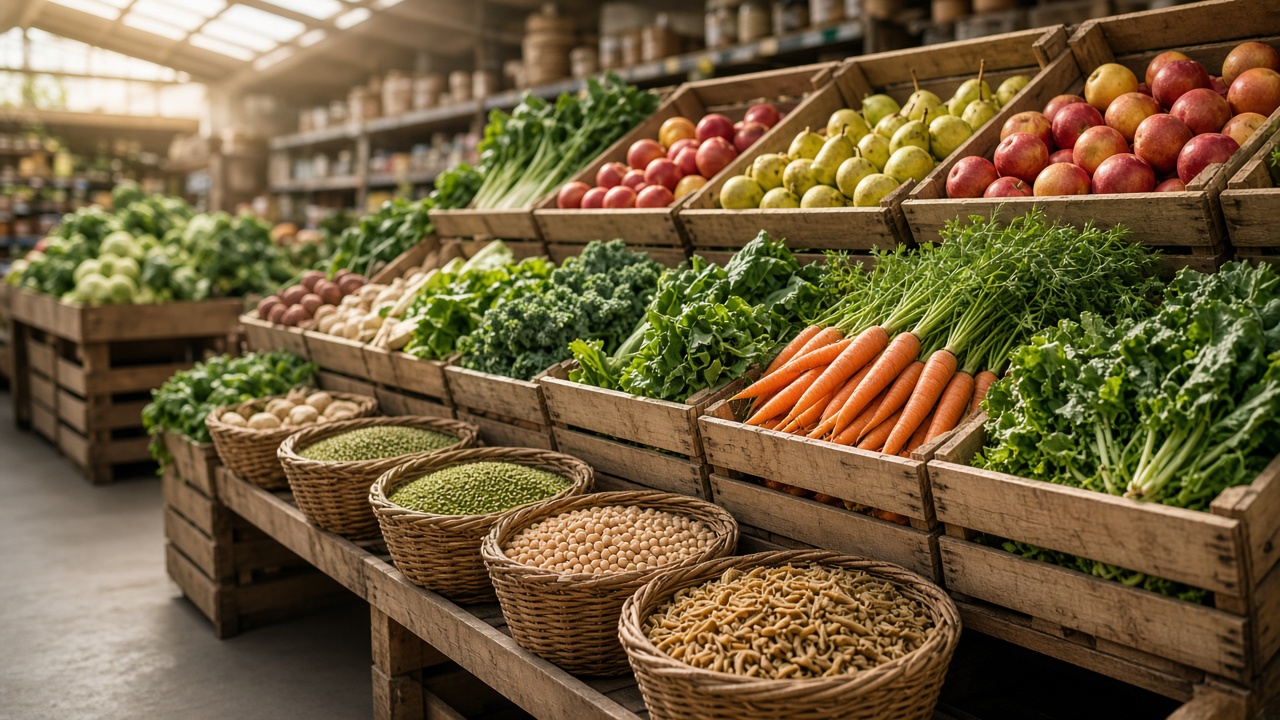
100 healthy foods at cost price: what the bill proposes
Fruit, vegetables, pulses and wholegrain cereals sold in supermarkets with no profit margin: that is the aim of a bill currently being examined by the French Parliament.
Presented as a response to the difficulties many people face in eating a balanced diet, the measure could ease some household spending. But it has not been adopted yet, and not all of its details are settled. Here is what it would actually change, and how you can draw on it today to organise family meals better.
A bill, not yet a new rule
On 17 September 2026, a coalition of 42 organisations representing consumers, patients, health professionals and anti-poverty groups called on members of Parliament to back the creation of a basket of health-friendly foods sold at cost price.
The scheme is now carried by two similar bills:
- one tabled in the Assemblée nationale (the lower house of Parliament) on 23 July 2026;
- another tabled in the Sénat (the upper house) on 2 September by Senator Antoinette Guhl and several of her colleagues.
The Senate bill has been sent to the Economic Affairs Committee, but it has not been voted on yet. Supermarkets are therefore not subject to any new obligation today.
In other words, the "healthy basket at cost price" is a political proposal under review, not a benefit already available in store.
What exactly does "at cost price" mean?
A product sold at cost price would not be free, and its price would not simply match what the retailer paid the supplier.
Under the bill tabled in the Senate, the price could include the costs directly needed to sell it:
- buying the product;
- transport and handling;
- storage and preservation;
- shelving and checkout;
- the related staff and energy costs;
- a share of the store's shared overheads;
- losses actually recorded.
On the other hand, no profit margin could be added. General advertising spending and costs with no direct link to the product would also be excluded.
A product sold at cost price would therefore not necessarily be the cheapest on the shelf. An organic or French-grown item, for example, could still cost more than a conventional entry-level own-brand product. Its price, however, would be calculated without any commercial profit for the retailer.
Which stores would be affected?
As currently drafted, the bill would target food retailers:
- with a sales area of more than 400 m²;
- belonging to a network of at least five stores under the same banner.
Small independent grocers and most local convenience shops would therefore be exempt.
The products would have to be available at all times, clearly labelled on the shelves and flagged on the retailer's website. When an item became unavailable, it would normally have to be replaced by a product from the same family within 30 days at most, subject to seasonal or supply constraints.
Would it really be 100 products?
The phrase "100 healthy products at cost price" comes from the campaign launched by Familles Rurales (a national family association), foodwatch, Secours catholique (a Catholic anti-poverty charity) and their partners.
The parliamentary text is slightly different: it sets a minimum of 80 distinct items over the calendar year. A government decree could then set a higher number and move closer to the 100-product target championed by the associations.
Simply changing the brand, format or weight of the same food would not count as several items. The basket would also have to offer at least three products in each major food category concerned.
This detail is meant to prevent an artificially long list made up, for example, of several pack sizes of the same pasta.
Which foods could be in the basket?
The final list does not exist yet. It would be set by decree after consulting, among others, Anses (the French food safety agency) and national consumer associations.
The selection would be based on the recommendations of the Programme national nutrition santé (PNNS, France's national nutrition and health programme). The list drawn up beforehand by the associations does, however, give an idea of the products likely to be included:
- fresh seasonal fruit and vegetables;
- plain frozen or tinned fruit and vegetables;
- lentils, chickpeas, beans and other pulses;
- pasta, rice, flour, bread and cereals, particularly in semi-wholegrain or wholegrain versions;
- eggs;
- milk, plain yoghurts and some cheeses;
- fish;
- unsalted nuts;
- rapeseed, olive or walnut oil;
- basic ingredients for cooking at home;
- some baby foods.
The associations also suggest that a significant share of the basket should come from organic farming and that French-grown products should be given prominence.
The Senate bill does indeed provide for nutritional, quality and environmental criteria to be defined, along with a minimum proportion of organic items or items in conversion to organic.
Would farmers end up bearing the cost?
This is one of the main concerns. A lower shelf price must not be achieved by cutting what the producer or supplier is paid.
The bill explicitly forbids retailers from passing the cost of the scheme on to them. Including a product in the basket could not be used as a reason to:
- lower its purchase price;
- demand an extra discount;
- worsen payment or delivery terms;
- charge for an unjustified commercial service;
- cut the volumes ordered on other products without good reason.
In principle, then, the effort would come out of the retailer's margin. Enforcing and monitoring this safeguard would nonetheless be a major challenge if the bill were adopted.
What would a family gain?
It is still impossible to put a figure on average savings. The products selected, their current prices and the margins applied vary from one chain and one store to another.
The main benefit would be having, in every supermarket concerned, a clearly identifiable core range of foods in line with nutritional guidelines.
A family could then compare products more easily and build its menus around a few affordable basics: vegetables, pulses, grains, eggs, plain dairy products or fish.
But the presence of cost-price items would not, on its own, guarantee a significant drop in the till receipt. Savings would still depend on the quantities bought, the recipes chosen and whether the food is used up completely.
A big bag of cheap vegetables is still a bad deal if half of it ends up in the bin.
How to build your own budget-friendly healthy basket now
Choose foods that work across several meals
A versatile product is often better value than an ingredient bought for a single recipe.
Carrots can be eaten grated, roasted, then added to a soup. Lentils can go into a dhal, a pasta sauce or a salad. Eggs make an omelette, a quiche or a backup meal.
The goal is to give every quantity you buy a specific purpose.
Mix fresh, frozen and tinned
Fresh is not always cheaper, and frozen or tinned foods are not just second-best substitutes.
Plain frozen vegetables are easy to portion and limit waste. Chopped tomatoes, chickpeas and tinned beans keep the end-of-week meals on track. Fresh produce remains particularly worthwhile for raw salads and seasonal foods eaten quickly.
A balanced list might therefore include:
- three versatile fresh vegetables;
- two plain frozen vegetables;
- two or three tins of vegetables or pulses;
- fruit chosen according to price and ripeness.
Compare the price of what you actually eat
The price per kilo or per litre remains an essential benchmark, but you also need to factor in trimmings and the risk of waste.
A slightly more expensive product can work out cheaper if it keeps better or can be portioned precisely. Conversely, a large pack that looks good value per kilo only saves money if all of it is used.
Plan quantities before you shop
The best way to keep the basket under control is to work out:
- the week's meals;
- how many people will be eating;
- the ingredients you already have;
- the quantities needed;
- the products that can be used in several recipes.
This preparation also helps you judge a special offer properly or, in future, an item sold at cost price.
Example family basket inspired by the scheme
Without waiting for the outcome of the parliamentary debate, a family can build its own shopping core around simple products:
- carrots, cabbage and squash, depending on the season;
- frozen spinach and green beans;
- chopped tomatoes;
- lentils and chickpeas;
- rice and semi-wholegrain pasta;
- eggs;
- plain yoghurts;
- tinned sardines or mackerel;
- apples or pears;
- rapeseed or olive oil.
This selection can be used to make a hearty soup, a lentil curry, vegetable pasta, an omelette, fried rice or a chickpea salad.
The real saving then comes from combining affordable products, the right quantities and recipes planned together.
A cheaper basket only helps if it matches your meals
The proposal for 100 healthy products at cost price raises a key question: how can a balanced diet be made genuinely affordable, beyond theoretical recommendations?
If adopted, the measure could make it easier to spot and buy certain essential foods. It will not, however, replace meal planning or working out quantities.
GustoPlan fits precisely into this approach: recipes are selected according to your household's profile and preferences, then turned into a shopping list with exactly what you need, no more, no less. You stay in control of which ingredients you buy and their quality, while the quantities match the meals you have actually planned.
Whether they end up sold at cost price or simply bought at the best price, the most economical products will always be the ones that all find a place on the week's menu.
Sources
- Proposition de loi au Sénat (Senate bill)
- France Assos Santé: appeal of 17 September 2026
- Familles Rurales: campaign for 100 foods at cost price