Grocery shopping is not just about buying what is missing.
It is often a moment where you lose time, forget things, and end up buying more than planned.
You leave for “just a few products”, and you come back with a longer receipt than expected, a missing ingredient for tonight’s dinner, and that unpleasant feeling of having done all this without a real method.
The good news is that there is a simple solution: preparing a shopping list by aisle.
It is not revolutionary. But in real life, it changes a great deal.
A well-organised list lets you:
- save time in the store,
- avoid pointless back-and-forth,
- reduce forgotten items,
- keep your budget under control,
- and make the whole week run more smoothly.
Here is how to do it simply.
Why a classic shopping list is not always enough
Many people write a “raw” shopping list, noting products as the week goes by:
- milk
- tomatoes
- yoghurts
- …
The problem is that this list follows the order in which ideas arrive, not the order of the store.
The result: you walk the same aisles several times, you lose the thread, you forget a product, then you improvise. And the more you improvise, the more you buy on impulse or out of tiredness.
A shopping list by aisle puts some order back into all this.
Why sorting your list by aisle really changes shopping
When the list follows the logic of the store, shopping becomes much more fluid.
Instead of thinking at every moment, you move aisle by aisle:
- fruits and vegetables,
- pantry,
- fresh products,
…
It sounds simple, but this order dramatically reduces the mental load. You no longer keep wondering what is left to buy or where you need to go back.
It is also very useful when shopping tired, in a hurry, with children, or at the end of the day.
A good list does not just save time. It also keeps you from wearing yourself out on a repetitive task.
Build your list from the meals you planned
The most effective approach is not to write a list “at random”, but to build it from the meals you have planned.
For example, if the week includes:
- a chicken and vegetable rice,
- a quiche with salad,
- wraps,
…
then the list becomes much more coherent. You buy what will actually be used, instead of filling the trolley with no overall vision.
It is also how you avoid one of the biggest shopping traps: buying products that seem useful in the moment but do not fit into any specific meal.
When meals are planned before the shopping, everything becomes simpler.
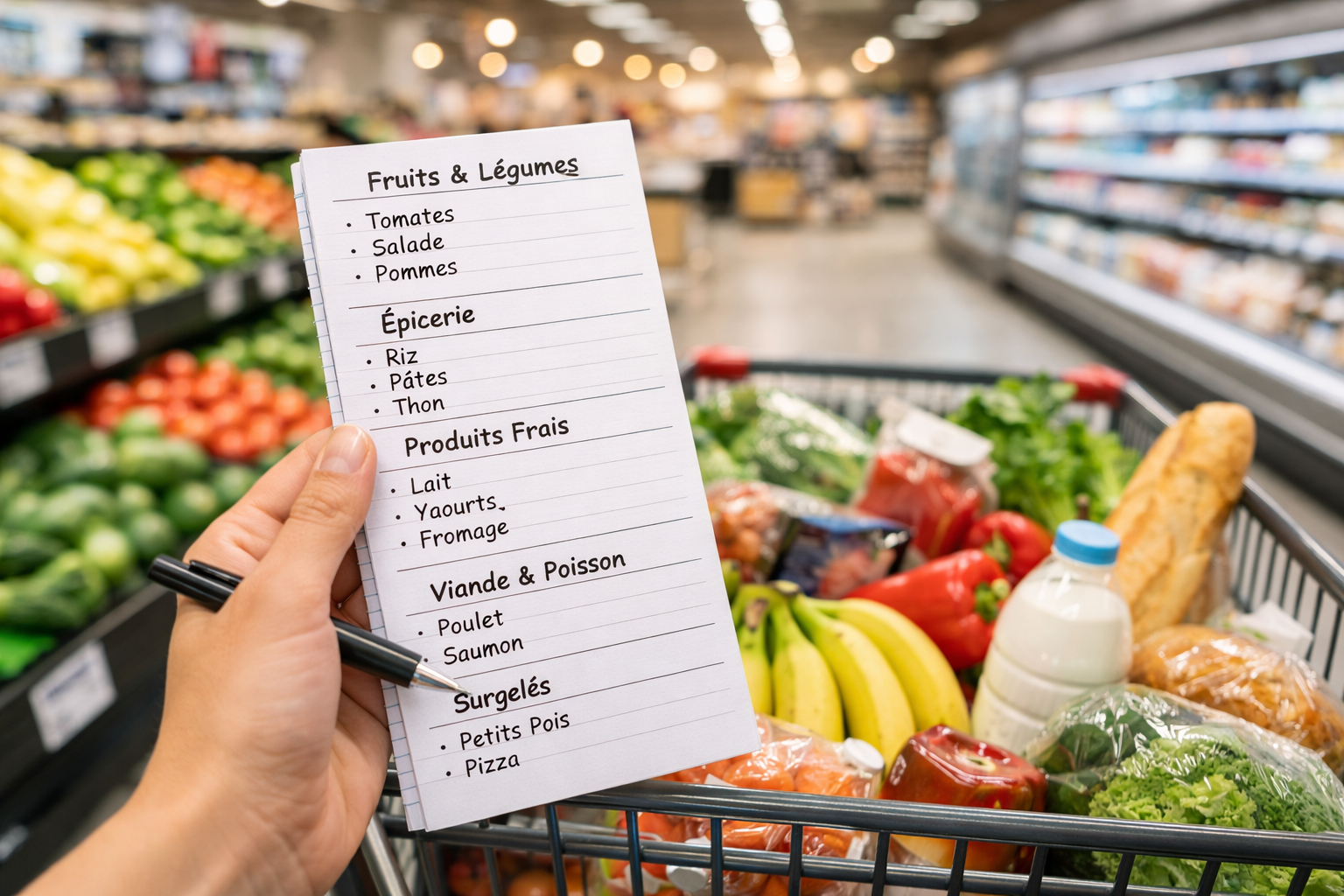
A concrete example of a shopping list by aisle
Let’s take a simple example for a classic week.
Fruits and vegetables
- tomatoes
- salad
- courgettes
Pantry
- rice
- pasta
- wraps
Fresh products
- milk
- yoghurts
- grated cheese
Meat and fish
- chicken
- white fish
Frozen food
- peas
- mixed vegetables
Bakery
- bread
- sandwich bread
Household / cleaning
- washing-up liquid
- paper towels
With a structure like this one, the trip through the store becomes much faster and much easier to follow.
How to avoid the most common oversights
Forgotten items are not always the main products. It is often the “little things around them” that are missing:
- cream for a quiche,
- garlic to season a dish,
- grated cheese,
To avoid that, it helps to reread the list while asking three simple questions:
- Does every meal have all its ingredients?
- Is a side dish missing?
- Do I already have some basics at home?
This reread takes two minutes, but it prevents a lot of emergency purchases.
A good list also helps you manage the budget
A shopping list by aisle is not just about organisation. It is also a good lever to keep spending under control.
When you know what you came to buy, you limit:
- impulse purchases,
- duplicates,
- “just in case” products,
- and ingredients you will forget to use.
You also spot more easily what makes the bill climb: processed products, snacks, extras, misleading promotions, ready meals, emergency purchases.
In short, a well-thought-out list helps you buy what is useful.
Why this method also reduces waste
Food waste rarely starts at the moment you throw something away. It often starts at the moment you buy without a clear plan.
A cucumber bought with no precise idea, a forgotten punnet of mushrooms, an opened pack used for a single recipe… all of this often ends up lost.
Conversely, when shopping is tied to specific meals, products circulate better through the week.
For example:
- tomatoes serve a salad and some wraps,
- potatoes go into an oven dish then a soup,
- grated cheese covers a quiche and a pasta dish.
This simple logic naturally reduces waste.
Paper, phone notes or an app: which is most practical?
Paper works very well, especially to start. A note on your phone can also do.
But as soon as you want to go faster, tie the shopping to the meals, or stop rebuilding everything each week, an app becomes useful.
The point of a tool like GustoPlan is not just writing a list.
It is making the link between:
- the household’s preferences,
- the planned meals,
- the required ingredients,
- and an already structured shopping list.
In other words, you spend less time organising, and more time cooking what really matters.
The simplest way to start this week
No need to revolutionise everything at once.
To begin, just do this:
- choose 4 to 6 meals for the week,
- write down the required ingredients,
- group the products by aisle,
- check what you already have in the cupboards,
- keep one or two simple backup meals.
This method is already enough to make a real difference on time, budget and peace of mind.
Conclusion
A shopping list by aisle is a small habit that changes a lot of things.
It makes shopping faster, clearer, less tiring.
It helps you track your budget.
It limits forgotten items and reduces waste.
And above all, it fits perfectly into a simpler, calmer way of organising meals.
When meals and shopping work together, the whole week becomes easier to manage.