Sugar tax 2027: which products, and what impact on your grocery bill?
Biscuits, breakfast cereals, cereal bars, factory-made pastries: several everyday products could be hit by a new tax from 2027.
The measure is part of France's draft Social Security budget, but it still has to be examined by Parliament. So it changes nothing about the prices on the shelves today. Here is what the text provides for, what it is reasonable to anticipate for the family budget, and how to adapt your shopping without banning every sweet product.
An extension of the "soda tax", not a general tax on sugar
France already applies a levy on certain drinks containing added sugars or sweeteners. Article 8 of the 2027 Social Security financing bill (PLFSS, the annual bill that sets the health and welfare budget) proposes extending this mechanism to pre-packaged foods that contain both sugars and certain additives.
The main targets are:
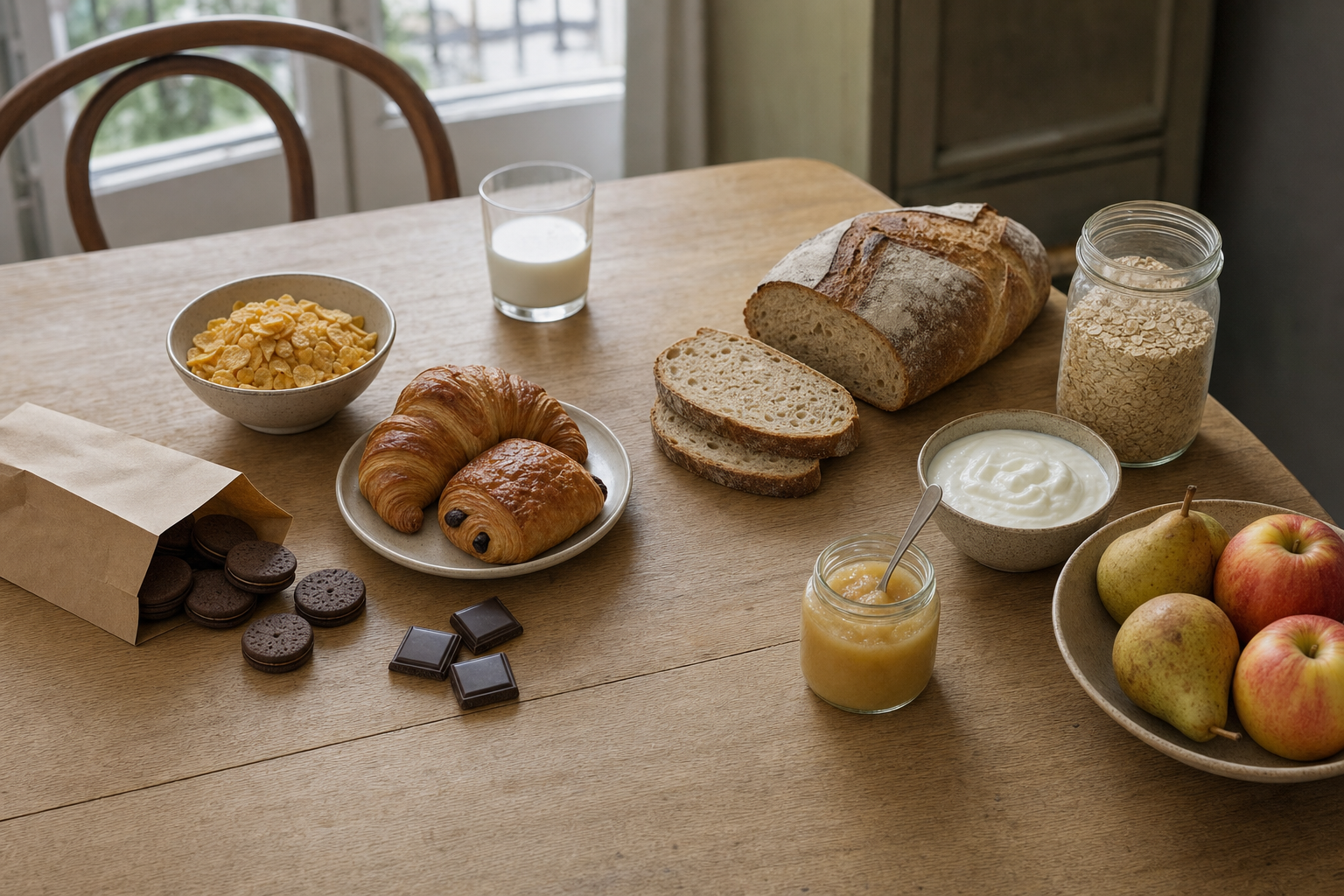
- factory-made pastries (viennoiseries such as croissants and pains au chocolat);
- packaged biscuits and cakes;
- some breakfast cereals;
- cereal bars;
- confectionery;
- chocolate products.
The scheme would start at 10 grams of sugars per 100 grams. The rate would then rise with the sugar content, up to 22 euros per quintal (100 kilograms) of product. A separate scale is planned for products that use certain synthetic sweeteners.
So this is not a tax on every food that contains sugar. An apple, a plain yoghurt, oat flakes or a homemade cake are not affected. Packaging, composition, the presence of additives and sugar content all come into play at the same time.
The measure does not apply yet
The 2027 PLFSS was presented to the Council of Ministers (the weekly French cabinet meeting) and tabled in the National Assembly on 1 October 2026. Members of both houses will be able to change the thresholds, the rate scale and the product categories, or drop the measure altogether. Similar proposals were in fact rejected by the Assembly in November 2025.
No family needs to rework its budget in a hurry, then. The government hopes to raise around 300 million euros from this extension, but that figure is estimated public revenue, not the extra cost each household would bear.
How much could prices go up?
The rate scale only gives a theoretical order of magnitude. The maximum rate of 22 euros per 100 kilograms works out at 22 cents per kilogram, or roughly 6.6 cents for a 300-gram packet.
That is not a forecast of the shelf price. The manufacturer can absorb the levy, change its recipe to drop below a threshold, cut sugar or certain additives, change the pack size or raise its price; the retailer can also adjust its margin.
The food industry expects the tax to be passed on to consumers and disputes its effectiveness. The government presents it as a way to encourage the reformulation of the sweetest products. The real effect can only be measured after it is adopted, if it is.
How to spot products likely to be affected
No need to wait for a future logo: three pieces of information already on the packaging are enough to compare.
- Sugars per 100 grams. This is the "of which sugars" line in the nutrition table. The per-100 g value is more reliable than the per-portion figure, which each manufacturer defines in its own way. Going over 10 g does not mean the product will be taxed: the other criteria must also be met.
- The ingredients list. It is ordered by decreasing quantity. Sugar can hide under several names: glucose syrup, glucose-fructose syrup, honey, fruit juice concentrate. The list also lets you spot additives.
- The price per kilogram. A less sugary product is not necessarily cheaper. For the same use, compare the price per kilo and the number of portions actually eaten.
Should you cut out biscuits and chocolate?
No. A biscuit, a pastry or a few squares of chocolate still have their place in a family diet. Frequency, quantity and the balance of the week matter more than any single purchase.
The risk would be to rush into replacing everything with products carrying reassuring claims that are more expensive or just as processed. "No added sugars" does not mean sugar-free, and a product made with sweeteners could also fall within the scheme.
A more realistic approach: keep the sweetest products for certain occasions, and have two or three simple options for the other days.
Simple breakfasts with few purchases
A handful of foods that combine well is enough to vary your mornings:
- oat flakes;
- milk or a suitable plant-based drink;
- plain yoghurts;
- bread;
- fresh seasonal fruit;
- no-added-sugar fruit compote;
- eggs;
- possibly a few unsalted nuts.
They let you alternate between porridge, yoghurt with oat flakes, bread with fruit, or egg and bread. Not everyone has to eat the same thing: what matters is not having too many perishable products open at once.
Five after-school snacks with shared ingredients
An example rotation for the goûter (the traditional French after-school snack), to adjust for age, appetite and any allergies:
| Day | Snack |
|---|---|
| Monday | Bread and a few squares of chocolate |
| Tuesday | Plain yoghurt and fruit compote |
| Wednesday | Homemade cake baked for several portions |
| Thursday | Fruit and bread with a spread |
| Friday | Shop-bought biscuit and fruit |
This plan does not cut out biscuits or chocolate: it stops a packaged product from becoming the automatic choice. Bread, fruit, yoghurt and compote also serve at breakfast, and the homemade cake can be cut into portions and frozen.
Homemade is only economical if the ingredients go into other recipes and every portion gets eaten. Buying several flours and decorations for a single bake would have the opposite effect.
Four habits to protect the budget
- Compare before you replace. If a usual product goes up, compare its price per kilo with two equivalent products, then their sugar content. Switching brands or buying the biggest packet guarantees no saving.
- Put snacks on the shopping list. School canteen, activities and weekends change what you need: counting the snacks actually eaten at home stops you buying five packets "just in case".
- Keep a backup option. Bread in the freezer, compote, oat flakes or long-life yoghurts spare you the top-up shopping trip, which is often an occasion for unplanned purchases.
- Look at the price of what gets eaten, not just the shelf price. A value pack stops being good value if portions grow or part of it goes stale.
Plan ahead without upending your habits
The sugar tax proposed for 2027 could speed up the reformulation of some products and lead to a few price adjustments. But its text can still be substantially changed in Parliament.
So the most useful response is not to cut everything out: it is to know what is in the products, compare prices and give every purchase a clear role.
GustoPlan follows the same logic: meals are planned according to the household's make-up and preferences, then turned into quantities and a shopping list. Versatile ingredients are spread across several recipes, and occasional purchases remain informed choices.
Taxed or not, the most expensive products will remain those bought without a clear purpose. An organised week leaves room for simple meals as well as sweet treats, without losing sight of the budget.
Sources
- Sécurité sociale: PLFSS for 2027, presented on 1 October 2026
- Assemblée nationale: legislative file for the 2027 PLFSS
- Reuters: main measures of the 2027 budget, 1 October 2026
- NosParlementaires: analysis of article 8 of the 2027 PLFSS
- Assurance maladie: reading labels and comparing products