Weekly menu: the simple method to eat varied meals without overspending
We have all been there: it is almost 7pm, everyone is getting hungry, and the big question drops.
“What’s for dinner tonight?”
The problem is not just a lack of ideas. It is that in everyday life — between work, family, surprises and tiredness — deciding what to eat becomes one more mental load.
That is exactly why building a weekly menu can genuinely change your daily life.
No need to be ultra organised, or to cook like a chef. With a simple method, you can:
- save time,
- cut out pointless shopping trips,
- keep your budget under control,
- eat more varied meals,
- and avoid last-minute improvised dinners.
Here is a practical method to build a weekly menu easily.
Why plan a weekly menu?
Planning your meals ahead is not just an organisation fad. It is above all a way to make your life simpler.
When meals are decided in advance, you drastically reduce the small daily decisions. You know what to buy, what to cook, and you stop circling the fridge hoping a dinner will appear by magic.
Planning a weekly menu also helps you manage your shopping better. You buy what is useful, you throw away less, and you avoid duplicate purchases or ingredients forgotten at the back of a cupboard.
Finally, it is a good way to bring some balance back to the plate. Without chasing perfection, you can spread vegetables, starches, proteins, quick dishes and more generous meals far more easily.
Start from real life, not from an ideal menu
The most common mistake is trying to build a “perfect” menu.
In reality, a good menu is above all a menu adapted to your actual week.
Before picking meals, ask yourself a few simple questions:
- How many evenings will really be available for cooking?
- Are there activities, late returns, meals out?
- How many people will be eating at home?
- What grocery budget do you want to stick to?
- Do you have specific preferences or constraints?
A busy week does not call for the same menu as a quiet one. The goal is not to impress, but to last.
Plan simple meals before ambitious ones
When organising your meals, it is best to start by securing the complicated days.
For example:
- a sports evening or a late return = a very quick meal,
- a quieter evening = a slightly more complete recipe,
- a lunch at home = leftovers or a dish prepared the day before.
This logic changes everything. Instead of first picking recipes that look appealing, you build a menu that actually stands a chance of being followed.
An effective weekly menu is not the one that looks best on paper.
It is the one you manage to stick to without stress.
Vary without complicating
We often think that varying meals requires lots of ideas. In reality, variety mostly comes from a good rotation.
A balanced week can simply alternate:
- a chicken or turkey dish,
- a vegetarian meal,
- a fish dish,
- an easy family meal like pasta or a gratin,
- a “fridge-clearing” dinner or upgraded leftovers.
The simplest approach is to vary from one week to the next using a few markers:
- the main base of the meal,
- the type of side dish,
- the cooking method,
- and the level of effort required.
You can eat varied meals without inventing seven completely different recipes every week.
Reuse ingredients intelligently
This is one of the most useful secrets of a budget-friendly weekly menu:
making the same ingredients circulate across several meals.
For example, a single bag of rice can serve for:
- a chicken with vegetables,
- a grain bowl,
- and a side dish the next day.
Vegetables like courgettes, carrots, potatoes or onions can go into several recipes without ever feeling like you are eating the same thing.
This approach has two huge advantages:
- it lowers the overall cost of your shopping,
- and it limits waste.
In other words, a good menu is not a series of isolated meals. It is a coherent whole.
Leave room for flexibility
The classic trap is planning the whole week to the minute, then giving up at the first surprise.
A useful menu must stay flexible.
For example, you can plan:
- 4 or 5 proper planned meals,
- 1 meal based on leftovers,
- 1 very simple backup meal.
The backup meal can be a household classic: omelette, soup, pasta, toasted sandwich, mixed salad, or any quick meal that takes little energy.
That margin prevents frustration. You stay organised without pressuring yourself.
Build a shopping list from the menu
This is where a lot of time is saved.
Once the meals are chosen, simply turn the menu into a clear shopping list. The best way is to group products by aisle:
- fruits and vegetables,
- pantry,
- fresh products,
- meat and fish,
- frozen food,
- breakfast and extras.
This organisation makes shopping faster and easier to read. It also stops you buying “at random”, which is often what makes the bill climb.
When the menu is planned ahead, the shopping list becomes a logical consequence, not a separate chore.
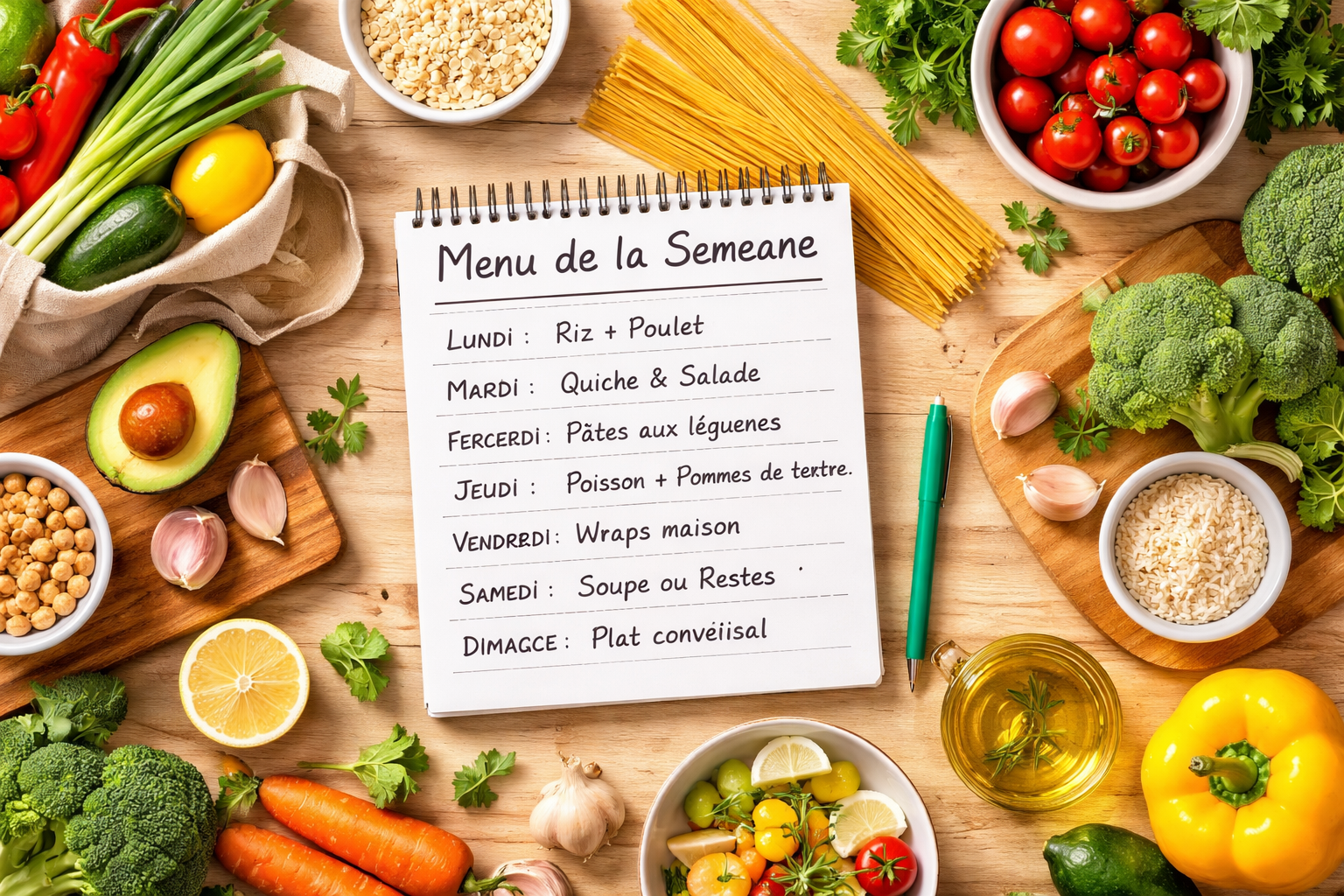
A simple example of a weekly menu
Here is a very simple example of a family menu, without chasing performance:
Monday: rice, chicken and pan-fried vegetables
Tuesday: quiche with salad
Wednesday: pasta with tomato sauce and vegetables
Thursday: oven-baked fish with potatoes
Friday: homemade wraps with crudités
Saturday: soup or upgraded leftovers
Sunday: a convivial, slightly more generous dish
This kind of base works well because it mixes:
- quick meals,
- familiar dishes,
- a bit of variety,
- and a real budget logic.
Why we often give up after two weeks
It is usually not a motivation problem.
It is that the method used is too heavy.
We often give up when:
- the menu requires too much thinking,
- the recipes are too complicated,
- the budget is not taken into account,
- or everything rests on memory and good will.
To last over time, you need an organisation that is simple, repeatable, and adapted to your daily life.
That is exactly the idea behind GustoPlan: helping you build realistic menus based on your household, your budget, your available time and your preferences, without starting from scratch every week.
Conclusion
Planning a weekly menu is not just about “being better organised”.
It is a concrete way to take back control of your daily life.
You save time.
You cut pointless spending.
You reduce the mental load.
And above all, you stop enduring meals day after day.
No need to be perfect. You just need a method that is simple, flexible, and adapted to your real life.
That is often where everything starts.
Want to prepare your meals faster?
GustoPlan helps you build menus adapted to your household, your budget and your preferences, with a clear and practical shopping list.