Cheaper organic groceries: where to shop in France, according to Que Choisir
To pay less for organic food, should you shop at supermarkets or at specialist organic stores? The answer is more nuanced than a simple ranking of retailers.
A survey published on 9 October 2026 by the French consumer association Que Choisir shows that supermarkets are generally better placed on a full basket. Specialist organic stores, however, become competitive, or even cheaper, on fruit and vegetables.
The best strategy is therefore not necessarily to change shops, but to know which products to compare first, and to plan your meals before filling the basket.
An organic basket compared across 16 retailers
Que Choisir Ensemble (formerly UFC-Que Choisir) compared the price of 42 equivalent organic products across 16 French retailers, both mainstream and specialist.
For the same product, the gaps can be huge: eggs were up to 90% more expensive at Comptoirs de la Bio than at Leclerc, and milk 75% more expensive at Naturalia than at So Bio.
Prices were collected between 22 November and 6 December 2025 in 605 shops belonging to 11 specialist chains; supermarket prices were taken from their click-and-collect services. The basket mixed fruit and vegetables, national brands and own-label products. Its average price was 130 euros at supermarkets and 158 euros at specialist organic retailers, a gap of 28 euros.
Organic stores are not more expensive in every aisle
That average hides a real difference between aisles. Excluding fruit and vegetables, specialist stores were on average 27% more expensive than supermarkets. But their organic fruit and vegetables were on average 10% cheaper.
Leclerc came out as the cheapest mainstream retailer. Among the specialists, Satoriz, So Bio, Biocoop and Marcel & Fils came out on top. These rankings are averages: the actual price depends on the shop, the region, the brands available and the time of year.
The useful conclusion is therefore neither "the supermarket is always cheaper" nor "specialists are unbeatable on fresh produce". It is simpler: the product category matters almost as much as the retailer.
What the survey does not tell you
A few precautions are needed. The study compares organic products with each other: it does not measure the gap between organic and conventional. The prices date from late 2025: they give a solid picture of retailers' pricing strategies, not a guaranteed price list for today.
Above all, a dramatic gap on eggs or milk is not enough to identify the cheapest shop for your family. It all depends on what you actually buy: a household that eats a lot of fruit and vegetables will not get the same ranking as one that spends mostly on dairy or store-cupboard products.
Should you shop in several stores?
Splitting your shopping can lower the bill, but only if the saving outweighs the cost of the extra trips: mileage, fuel, time, impulse buys, duplicate purchases, and different pack sizes that make quantities harder to track.
For most families, a realistic approach relies on one main shop and one secondary point of comparison. The supermarket can remain the place for store-cupboard items, organic eggs and dairy; a specialist shop or a market can be the place for fruit, vegetables and a few bulk products. There is no need to go every week: a detour every fortnight, or a monthly stock-up on dry goods, may be enough, especially if it fits into a trip you already make.
Buying organic without blowing the budget, in four steps
1. Choose your priority organic products. A fully organic basket is not the only option. Start with the foods your family eats often and for which organic matters most to you: fruit eaten with the skin on, a few regular vegetables, eggs, milk or yoghurt, pulses, rice, pasta or flour. Five organic products bought regularly and actually eaten are better than more expensive items that do not fit your menus.
2. Compare prices per kilo or per litre. A 400 g bag of pasta can look cheaper than a 500 g pack without being cheaper per kilo, and yoghurt multipacks quickly blur the displayed price. Then look at the quantity you need: a large pack is only worthwhile if it will be finished in time.
3. Compare by aisle rather than by retailer. The survey suggests an order of checks to test locally:
- organic fruit and vegetables: compare specialist shops, markets and supermarkets, bearing in mind the season and the risk of waste;
- eggs and dairy: look at supermarkets first, at the unit price;
- pasta, rice, flour and pulses: supermarkets and own-label products, then specialist bulk bins, at the price per kilo;
- tinned and frozen foods: compare between retailers, checking the ingredients and the drained weight;
- very specific products: organic stores, but not for a single recipe.
This is not a national verdict, just a way to avoid comparing the whole shop. And remember plain frozen vegetables and tins: they keep for a long time, are easy to portion and limit waste. A fresh product that is cheaper per kilo ends up costing more if half of it goes in the bin.
4. Plan your menus before looking at special offers. An organic special offer is still a bad deal if the product has no place in your week. Before shopping, check how many meals will really be eaten at home, what is left in the cupboards and which fresh products need using up. You will then pick offers that fit your menus, rather than changing your menus to use up an unplanned purchase.
Example: a targeted organic basket for five dinners
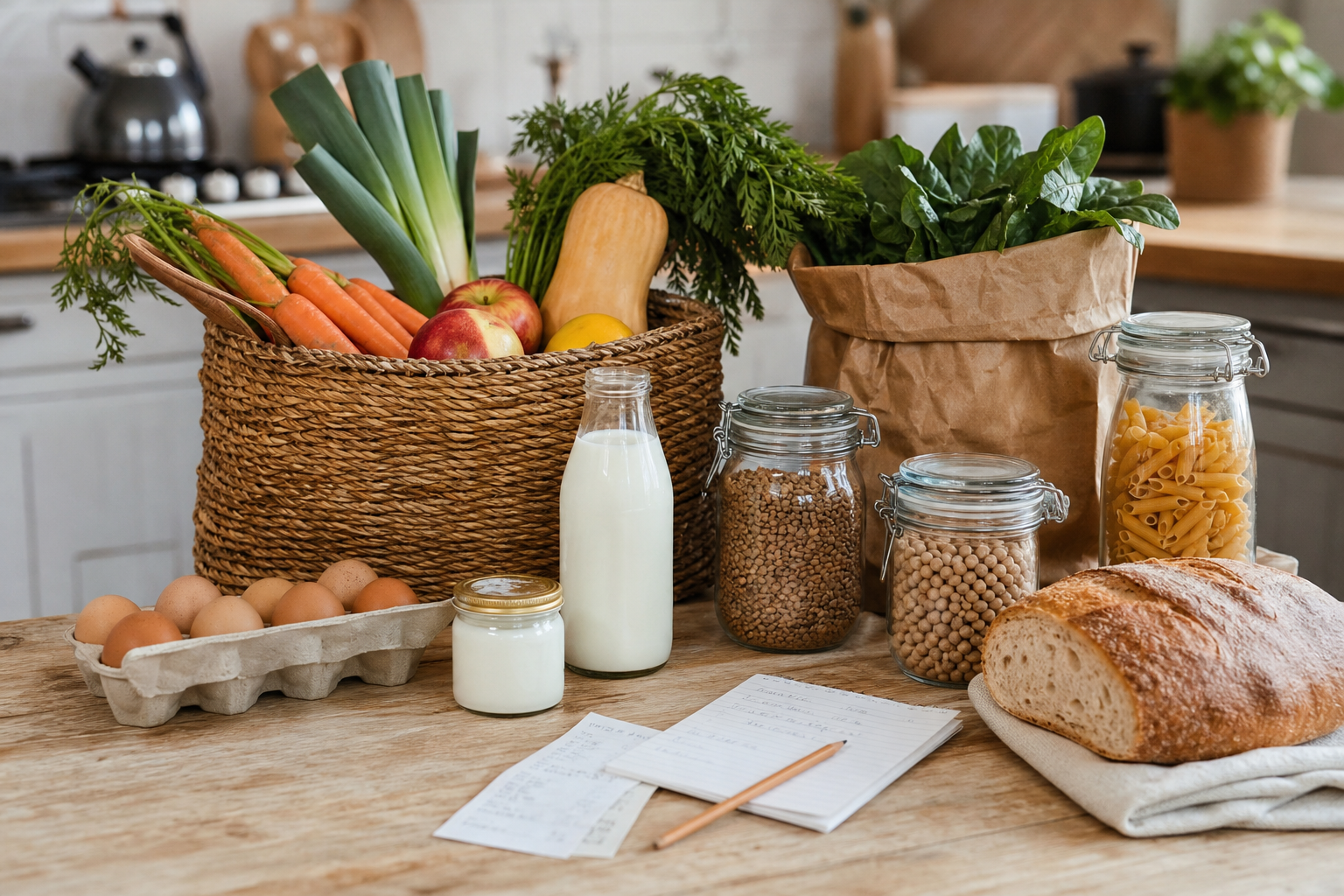
To bring in more organic food without changing the whole basket, a family can focus its organic purchases on a few versatile ingredients (carrots, leeks, apples, eggs, lentils, chickpeas, pasta) and add tinned tomatoes, plain frozen vegetables, plain yoghurt and bread.
Enough to make:
- a leek and potato velouté, with toast and an egg;
- pasta with lentils and tomato;
- a potato and courgette omelette, or one with whatever vegetables are left in the fridge;
- a chickpea curry with frozen vegetables;
- a harira with lentils and chickpeas, or a leftovers meal topped up with a soup.
Here, organic is concentrated on a base of foods used several times: fewer products, and less risk of waste.
A more affordable organic basket starts with the menus
The main lesson of the survey: no shop is always the cheapest for every organic product. Supermarkets keep the edge on the full basket and store-cupboard items; specialists can be competitive on fruit and vegetables. The most effective approach is to choose a few priority products, compare by aisle and avoid unprofitable detours.
GustoPlan makes this trade-off easier: meals are chosen to suit the household's tastes and constraints, then the ingredients are grouped into a list with the quantities needed. It is then up to you to decide which products to buy organic, where to buy them, and in which pack size so that they are fully used.
The goal is not to fill the basket with labels, but to choose the quality you want where it matters for your family, while giving every purchase a clear purpose.