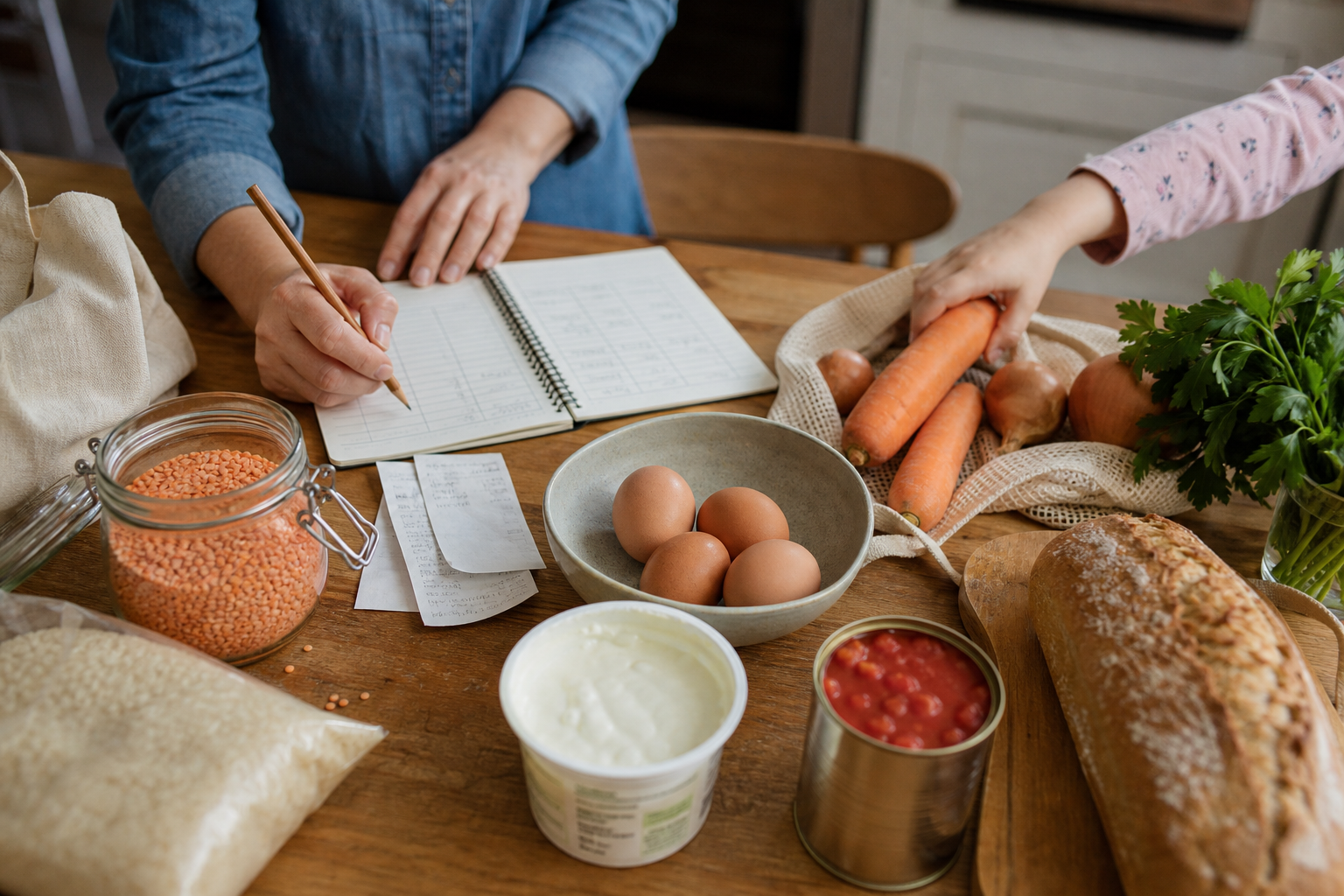
Food insecurity: protecting the family meal budget
Cutting unnecessary purchases, cooking with leftovers or comparing prices all help a budget go further. But when income no longer covers essential spending, no kitchen tip can solve the problem on its own.
A study published on 5 October 2026, based on data from the French charity Restos du Cœur, shows that turning to food aid is not limited to a fixed or marginal group of people. It can happen after a job loss, a rent increase, a separation or a build-up of unavoidable expenses.
The challenge is therefore twofold: protect family meals as far as possible, and ask for help early enough, without waiting until the fridge is empty.
One person in ten could need food aid
The study "Extreme poverty in rich countries", carried out by five economists, draws on data collected by Restos du Cœur between 2018 and 2025: 5.5 million people and more than 16 million observations.
According to its authors, around one person in ten in France could turn to food aid at some point over the next ten years. This is an estimate of the risk of going through at least one episode of hardship, not a forecast that 10% of the population will go without food at the same time.
These episodes are often temporary: support lasts around 18 months, but 14% of people remain in hardship for more than three years. In 2024-2025, Restos du Cœur helped 1.3 million people; half were under 25, and 23% of the families they supported were single-parent families.
The meal budget absorbs the strain from everything else
Food is one of the few household expenses that can be changed immediately. You cannot lower your rent overnight; you can, however, put off a shop, drop a product or finish what is left.
The meal budget thus becomes the adjustment variable for a higher energy bill, a car repair, medical costs, back-to-school expenses or rent that has become too heavy.
The study highlights the weight of housing and employment: all other things being equal, a 10% rise in unemployment is associated with an increase of around 13% in food insecurity, and a 10% rise in rents with an increase of 9%.
Better-organised shopping reduces waste, but it replaces neither an adequate income nor social policy.
Signs that the food budget is slipping
Difficulties do not necessarily begin when a family starts skipping meals. Several warning signs often appear first:
- groceries are regularly paid for with an overdraft;
- what is in the fridge no longer lasts until the next payday;
- adults eat smaller portions to protect their children's;
- fruit, vegetables, eggs or dairy products disappear from the basket for financial reasons;
- meals rely on a single starchy food for several days in a row;
- school canteen fees become hard to pay.
A one-off incident does not mean a household is tipping over. But when several of these situations keep recurring, it is time to take stock and look for the support available.
Work out what is really left
A grocery budget picked at random is not enough: you need to start from the money that is actually available. Add up the month's guaranteed income, then subtract housing and service charges, energy and water, insurance, essential transport, loan repayments, out-of-pocket health costs and compulsory expenses for the children.
What remains still has to cover food, hygiene, cleaning products and the unexpected. If there is regularly not enough, cutting back further on food will only hide the imbalance. It is better to contact a social worker or your local social welfare office (in France, the CCAS) quickly than to pile up silent restrictions.
Protect a core of family meals
As long as the budget still leaves some room for choice, planning helps keep meals varied and stops money going on purchases with no clear purpose.
Start from a few versatile ingredients. Two seasonal fresh vegetables, plain frozen vegetables, pulses (lentils, chickpeas, beans), eggs, tinned fish, a starchy staple (rice, pasta, couscous or potatoes), tinned tomatoes, fruit chosen according to price, plain yoghurt and bread frozen in portions. This list is neither compulsory nor universal: it simply shows that a small number of foods can go into many dishes.
Plan the menus before looking at special offers. With this base, you can make a chickpea curry with rice, a potato omelette, pasta with tomatoes and lentils, a rice salad with sardines, or a red lentil soup with slices of toast. A special offer is only worthwhile if the product fits into these meals, if it will really be eaten, and if it does not take the place of a more essential food.
Keep two back-up meals. Two dishes you can make from the store cupboard alone, such as pasta with sardines and frozen vegetables or lentils with rice and onions, avoid an emergency shop at the end of the week. They are there to absorb a delay or a difficult week, not to become the menu every evening.
When organisation is not enough, ask for help
Turning to food aid is not a failure of money management. These schemes exist precisely for periods when resources no longer cover essential needs.
Your local social welfare office or a social worker. In France, the municipal or inter-municipal social welfare office (CCAS or CIAS) assesses the situation and points households towards local schemes: food parcels, food vouchers, financial help, reduced canteen rates or a social grocery shop. Conditions vary from one town to another, so it is better to contact the one where you live than to assume you are not eligible.
Social and solidarity grocery shops. They offer products for a reduced financial contribution, often between 10 and 30% of the displayed price according to the French Ministry for Solidarity. Each shop sets its own access conditions, and access is granted for a fixed period, sometimes renewable. The advantage: you choose your own products, as in an ordinary shop.
Food aid charities. Social workers usually refer people to food parcel distributions. At Restos du Cœur, you need to register every year and show that your resources are insufficient. This support can also help identify difficulties with housing, employment, health or access to benefits.
It is best to take these steps as soon as difficulties become recurrent. As the study points out, it is far easier to prevent people from falling into extreme poverty than to help them out once it has set in.
Organise without guilt
Food insecurity is not the result of a lack of budget recipes. It depends first and foremost on income, housing costs, employment and access to benefits.
Planning remains useful as long as a household still has some room to make decisions: it limits waste, protects a few essential foods and shows exactly what is missing. GustoPlan can help with this part of the organisation, by adapting menus to the number of people and the household's preferences, then grouping the quantities into a consistent shopping list.
But when what is left to live on is no longer enough, the right decision is not to look for an impossible optimisation: it is to apply for the help the family is entitled to. Planning meals helps make the most of the resources available; asking for help can sometimes bring back the ones that are missing.
Sources
- Les Restos du Cœur: Grande pauvreté, ce que les données des Restos du Cœur dévoilent, 5 October 2026 (in French)
- Restos du Cœur press room: presentation of the study (in French)
- French Ministry for Solidarity: Les épiceries sociales et solidaires (in French)
- French Ministry for Solidarity: Les distributions de colis alimentaires (in French)
- Les Restos du Cœur: Accéder à l'aide alimentaire (in French)