Meal vouchers in France: what the reform would change for your grocery shopping
Doing your grocery shopping with titres-restaurant, the meal vouchers many French employers give their staff, could become a permanent option. A bill adopted in committee also provides for their use on Sundays and public holidays, and for the end of paper vouchers.
These changes do not apply yet: the text still has to be debated by the National Assembly and continue through Parliament. Here is what it provides for, what still applies today, and how to use this benefit to organise your meals better.
Adopted in committee, not yet a law
The Social Affairs Committee of the French National Assembly adopted its text on 7 October 2026. The debate in plenary session is due to start on 12 October. The Government has triggered the accelerated procedure, but the content can still be amended by MPs and then by senators.
It would therefore be premature to announce the definite end of paper vouchers or the immediate opening of Sunday payments.
As currently drafted, the reform would come into force on 1 January 2028. Until then, a transitional provision would extend by one year, to 31 December 2027, the possibility of buying any food product with meal vouchers.
What you can pay for today
Until 31 December 2026, meal vouchers can be used to buy any food product, whether or not it is ready to eat: pasta, rice, flour, oil, meat, fish or vegetables. They can therefore pay for a ready-to-eat lunch as well as the ingredients of a meal cooked at home.
The current rules remain strict:
- the spending limit is 25 euros per day;
- vouchers are personal: only the employee can use them;
- on Sundays and public holidays, they are reserved for employees who work on those days;
- restaurants and shops are not obliged to accept them;
- each retailer sets its own list of products that can be paid for with meal vouchers;
- with a paper voucher, the shop does not give change; a card or app debits the exact amount.
Four proposed changes
1. Grocery shopping would become permanently eligible. The text redefines the meal voucher as a way to pay for a meal or "any food product used to prepare a meal". First introduced as a temporary measure in response to inflation, then extended several times, this option would become permanent.
Some categories of products that do not meet employees' meal needs could, however, be excluded by decree. That list is not yet known: we will have to wait for the implementing texts to know exactly what will be accepted at the till.
This would particularly benefit employees who bring a home-made lunch to work: they could choose between a restaurant, a takeaway and ingredients for their lunch box, without relying on a measure renewed from one year to the next.
2. Payment would be possible every day. The committee's text provides that meal vouchers can be used every day of the week, including Sundays and public holidays. An employee who works Monday to Friday could therefore do their Sunday shopping with their vouchers.
This flexibility matches the way many households are organised: a big shop at the weekend, several lunches prepared on Sunday, portions taken to work during the week. It would not, however, change the number of vouchers, their value or the 25-euro daily limit, which is set by decree rather than by this text.
3. Vouchers would become fully digital. Vouchers issued from 2028 onwards would be digital only, used by card or app. The practical advantage: only the amount actually spent is debited, and the balance is easier to track. This change does, however, raise questions about equipment, card acceptance and familiarity with apps, to be followed during the debate.
4. Donating vouchers would be made easier. Issuers would have to offer employees, at any time, the option of donating meal vouchers to approved national food aid charities. The text also provides for more transparency on the fees charged to shops and restaurants, and the possibility of capping them by decree. These measures affect employees' budgets less directly, but could encourage more small shops and restaurants to accept vouchers.
Would the reform increase the food budget?
Not directly: it creates no extra vouchers and does not increase their value. Above all, it would make them more flexible to use.
The possible gain comes from the freedom to spend vouchers on ingredients that suit the household's habits. An employee who prepares their own lunches can buy starchy foods, vegetables, eggs or fish rather than feeling obliged to choose a ready meal. And a Sunday shop would no longer have to be paid for some other way while a voucher balance is still available.
But paying with a meal voucher does not make a purchase economical. A pointless special offer, an oversized pack or an ingredient that ends up in the bin is still a bad buy, whatever the means of payment.
Making meal vouchers part of your shopping
Decide what they are for before you go into the shop. Should your vouchers mainly pay for lunches at restaurants, meals bought on office days, ingredients for lunches made at home, or a mix of all three? Deciding in advance stops you from using up the balance on impulse buys before the days when you need it most.
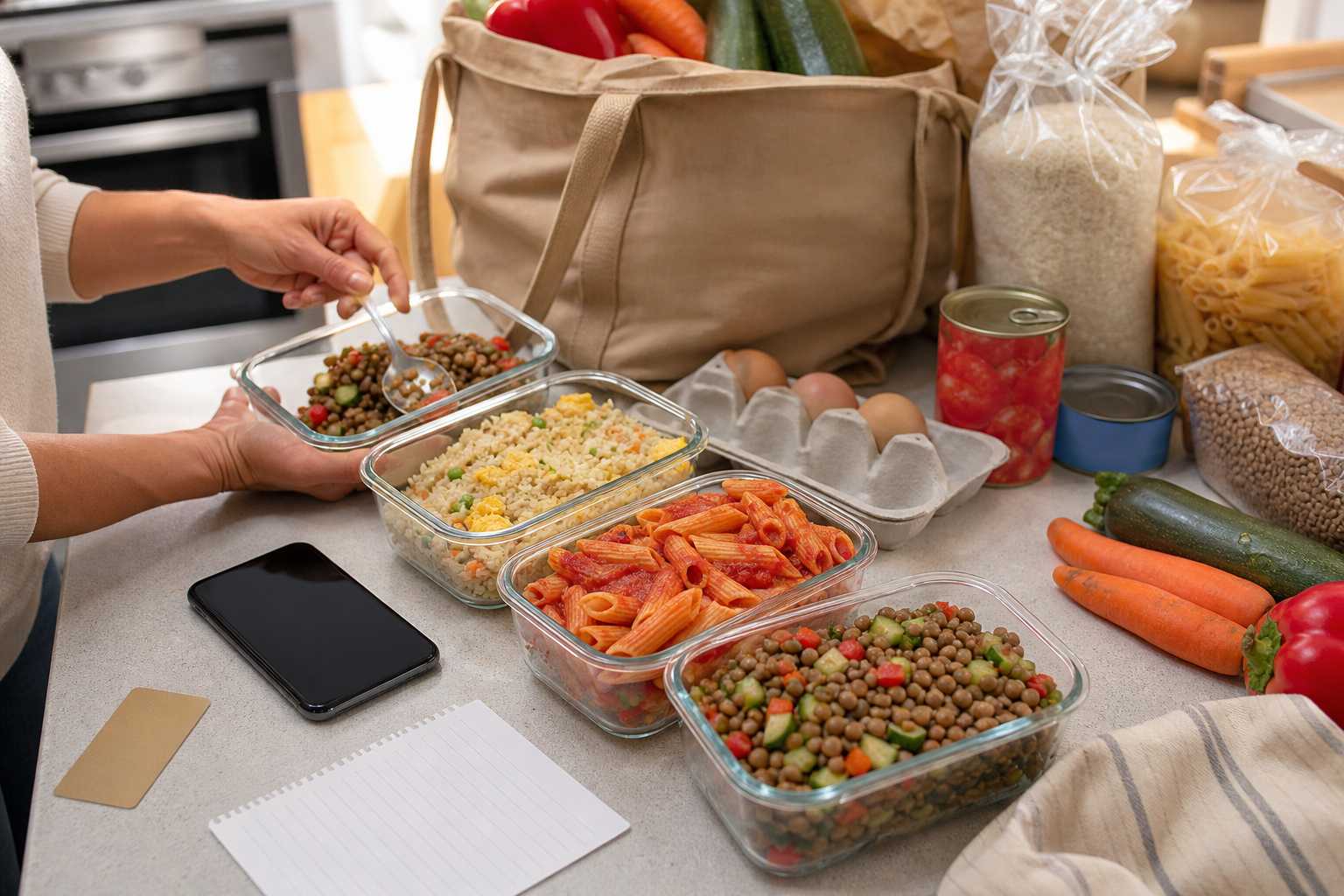
Plan your work lunches. Start by counting the meals you really need: working from home, business lunches, a staff canteen or days off all reduce the number of portions to prepare. A simple rotation can rely on a few shared ingredients:
- a lentil salad with tomatoes and cucumber;
- egg fried rice with vegetables;
- penne with tuna and tomatoes;
- a chickpea curry;
- leftovers from dinner, set aside as an individual portion.
Rice, vegetables, eggs and tomatoes go into several meals: the list stays short, and every purchase has a purpose.
Treat the 25 euros as a limit, not a target. There is no need to reach the daily limit. Adding a product just to "use up the vouchers" turns a benefit into an incentive to spend. Buy the quantities you planned, and top up with another means of payment if the basket goes over the limit.
Check the shop's rules. Even an eligible product can be refused depending on how the shop's tills are set up. Check the amount accepted before paying, especially on a first visit or for an online order, and have another means of payment ready for non-food items.
Remember that they are personal. Meal vouchers are given for the employee's own meal: using them for a family shop does not mean the card can be lent to someone else.
A reform in step with home cooking
According to the French Ministry of the Economy, around 5.5 million employees receive meal vouchers, accepted in some 243,000 approved outlets. Making grocery purchases permanently eligible would recognise an established reality: a work lunch is no longer necessarily eaten at a restaurant, it is also prepared at home with the ingredients from the weekly shop.
Sunday shopping would also make batch cooking easier. But it will not replace a precise list, suitable quantities and a quick look at what is already in the cupboards. GustoPlan builds menus around the people at the table and the household's preferences, then groups the ingredients into a shopping list: meal vouchers become a means of payment built into your planning, rather than a balance spent at random.
The reform still has to be voted on. In the meantime, the current rules apply: extended grocery purchases until 31 December 2026, a 25-euro daily limit, and Sunday use reserved for employees who work that day. The right approach: plan with the rules in force, and follow the rest of the parliamentary debate.
Sources
- National Assembly: legislative file on modernising and rebalancing meal vouchers (in French)
- National Assembly: text adopted by the Social Affairs Committee, 7 October 2026 (in French)
- Service-Public.gouv.fr: rules for using meal vouchers (in French)
- French Ministry of the Economy: Titres-restaurant, cap sur une réforme ambitieuse et équilibrée (in French)